Het gebruik van een auteursrechtelijk beschermd werk vereist voorafgaande toestemming van de auteur(s) en/of rechthebbende(n), maar wat als noodzakelijke informatie niet beschikbaar is? Bijvoorbeeld als auteur/rechthebbende onbekend is? Vele praktische problemen gaan over de contacteerbaarheid van deze: hoe worden de juiste naw-gegevens gevonden van een auteur met een veelvoorkomende naam? En wat als de auteur gevonden kan worden, maar de rechthebbende niet? Auteursrechtelijk beschermde werken waarvan de auteur niet op de sporen valt en/of niet te contacteren is, is het probleem van de zogenaamde ‘orphan works’.
In een geglobaliseerde (internet)markt gaat dit vaak gepaard met grensoverschrijdende aspecten. Het auteursrecht beschermd echter - zo vloeit voort uit artikel 5 van de Berner Conventie - conform het nationaal recht van de aangesloten landen.
Dit boek analyseert zowel management en contractuele modellen als wettelijke oplossingen voor deze wereldomvattende situatie. Het toetsingskader hiervoor houdt rekening met uitoefening van de morele en economische rechten, de rechtszekerheid, flexibiliteit en de kosten voor de mogelijke gebruikers, hoeveelheid actoren die betrokken zijn bij een rights clearance proces, en of wetgevende veranderingen en erkenning noodzakelijk en haalbaar zijn. Tot slot wordt een ontwikkeling geschetst hoe met dit probleem wordt omgegaan.
. . . English version is being drafted . . . be patient, pre-order now at the aforementioned mail address... Working title: "Orphan Works. In search of an international workable solution"
People one can now make a sarcastic notice 'markable' by using the SARCMARK TM. Of course anyone needs that¤(1). Interesting though is the use of different rights regimes to protect it, "equal rights for sarcasm"® the website claims(2): One claims copyright protection, made a trademark registration and there is a patent pending. On top of that Sarcasm is exploiting a punctuation mark with a licence.
Copyright protection
Copyright automatically is a right that derives from the sole creation of a work in the literairy, scientific and artistic domain(3). Still a work needs to be original and has to carry out the personal imprint of its creator. Sarcasm on the other hand is an abstract definition and it is difficult to capture it visually. I often misunderstand people in these sarcastic matters when it only comes in writing. So yes, I always missed the punctuation mark on my laptops keyboard ;) (-^').
It is with some doubt that the "dot with a squiggle" meets that criterium of copyright protection.
TM-registered
A trademark is a sign that distinguishes a company's goods or services. I think that SARCASM Inc. took the right decision to register(*) the punctuation dot with squiggle mark. Though isn't it strange to register a trademark and then you sell it non-exclusively towards online purchasers? In most times trademarks are being sold non-exclusively when one exploits a franchise-enterprise. But now it is being 'franchised' to a unknown number of individuals.
Though the value of the trademark registration that allows the registree to prevent the use of his punctuation mark is rather increased compared to the sole trademark use.
Patent pending
About the pending patent I have thought a while, but it actually make sense. First it has many similarities with the @-sign. Its first known use was by Medieval
munks to abbreviated the Latin word ad (at, toward, by, about) and used commercially by merchants to symbolize the word "per" (price "per/@" piece) and other similar uses(4). Nowadays the @-sign is commonly used in emailaddresses, since its introduction by Ray Tomlinson in 1971. He introduced this usage as a new form which didn't exist. Though as far as my research goes, it wasn't patented for this use.
Secondly patents can be granted, though it very much depends per country, that an invention claims to be new, inventive and useful or industrially applicable (5). Back to the SARCMARK:
the sign is new, since it has not been used for this purpose AND
inventive, probably a skilled person would not have come up with this solution to a social-cultural problem of 'not understanding sarcasm' AND
useful (that one is subjective and questionable), one could say it has a clear purpose, but if anyone would use it is worth a second thought, OR
industrially applicable, one could say that the sign is to be used in digital communication.
Until I could get a hand on the patent application, my guess would be that a patent might be granted*.
The software license
You acknowledge that the SarcMark Software is made available to You for Your personal use only and that You may download the software onto only one computer hard drive. Commercial use of the SarcMark Software must be approved in writing by Sarcasm, Inc. and its wholly owned subsidiary New Write, LLC. You agree not to (and agree not to assist or facilitate any third party to) copy, reproduce, transmit, distribute, publish, commercially exploit or create derivative works of the SarcMark Software(5).
The license only mentions terms and conditions relating to personal use of the SARCMARK software. Leaving the TM-issue mentioned above aside, the purchase of the SARCMARK Software does include the punctuation mark (remember the dot with squiggle). Does the license then include the terms and conditions for the use of the SARCMARK punctiation itself? The license is unclear about this. But since you purchase the license for the software just to use the mark, there are no limitations to the use of the mark itself.
So basically the use of copyright to protect a new introduced punctuation mark does work. But when one builds software around it, together with the software license, that allows the use of the software, it automatically means that there is a build-in license to use the punctuation mark itself without any restrictions that exceeds the original 'use of software' license.
I have been confronted with the question whether Parkour is illegal according to law(closed forum). This was the main question on parkour.nl, and I answered that it could be, in some cases and drafted a "best practise" guideline.
Along with that, the idea came along that it is better to prevent conversations with the police and people from the neighborhood and create an information brochure. Since Parkour is quite an unknown (urban) sport, especially in little villages. The brochure was easily made in one day after the initial idea.
Of course I used some pictures of others and I had some doubts but I think I solved the legal part.
First: Thanks to Malene Hald for the drawings she had put on her blog online: www.malenehald.dk
I have cited three of the six characters you have drawn and uploaded.
I gave credit to your name and to your blog.
I put your name in the "labels for this post"
Hopefully many people will try to reach your blog and maybe you'll get an assignment through my reference.
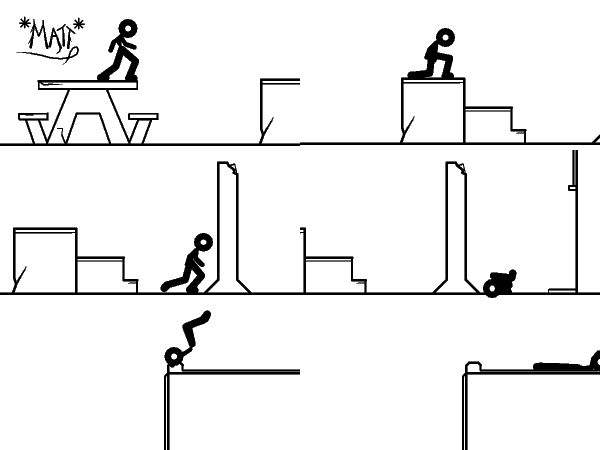
Secondly: Thanks to MATT-JAM3S for the GIF-file with stickfigures.
I have made three Prt Scrs and then editted the figures completely into a figure I found good enough for the brochure.
I have cited three screenshots out of a GIF-file.
I gave credit to your name and to the location of the GIF-file.
But I gave myself the credits for the composition, due to the fact that I have made it a totally different structure, idea and created a derivative work.
"Dit is Parkour": Dutch brochure (drafted: 7 octber 2009).
My sister (Yutta Sterenborg) is now getting into the business of "signmaking". So for all your T-shirts and commercial advertisement on e.g. windows, cars go to her homepage: www.yutta-style.nl. Due to that I have been thinking about infringement action by assistent parties.
Creating and developing T-shirts, car stickers, commercial window covers for restaurants, etc, is her main task. The assignments she gets often seems like an action infringing copyright or trademark laws. When she is using a logo with permission from the one who owns the logo, there is no problem whatsoever, like here:
When she is copying a logo from a trademark owner that is not the assignment giving person. Who is liable for the infringing action: Should the assigment giving person be the only one that can be held liable in court for an infringing action Could the one reproducing the trademark or copyrighted work held liable? Or is the reproducing person only a tool to infringe? Is there automatically a rule that says that the assignment giving person is liable for his actions?
In other words: What is her position?
In my view this could be settled with the use of general terms of agreement. Though in the signmaking business it is not quite a settled practice to hand over the general terms of agreement before or upon an agreement is reached. There is often only an oral agreement:
Assignment giving person: "Could you create a T-shirt that says: "All men are like wine, the older they get the better they become". Assignee: "Yes, I can..." and within 3 minutes a T-shirt seize, color, print is created and customly made for the individual.
But since the person giving the assignment (in the end) profits from the work created, in my view the assisting person is not to be held liable. There is often not much of credit for the person who created the tool for the assignment giving person. There are often more benefits/credits for the one who wears, drives or run a shop with a commercial window cover.
According to the law the assignment also ends upon delivery of a good product/service. After this there is no legal relationship left, unless there is something fundamentally wrong with the product or service, and as one might expect and ask for a repair (not being an copyright or trademark infringement).
Basically in my view, the assignee ceases to have any liability, when the custom-made good or product is delivered. During the time the assignment is not yet full-filled the assignement giving person could always refuse to accept the result. And in most of the cases, there is nothing made public yet and no infringement took place. Due to the fact that the assignement giving person accepts the product or service, he/she also receives the liability for the product or service.
The relationship between the two (assignment giver and assignee) should govern the legal infringement. And in my view the assignee should be protected in this matter, since the assignment giver profits from the work and paid (probably) a minimal lump sum compared to the possible legal infringment cost the assignee otherwise faces.
When the assignment giver explicitly pays a lot more, one could expect that the assignee took over the liability for infringement. Though an assignee might not be competitive enough if he/she does that and will not get any assignments.
But it really depends on the circumstances of each case. It should all be judged upon the own merit of the case.
===================================
All pictures are used under the exception of "Quotation", the copyright lies in the hands of Yutta Sterenborg (my sister) and can be seen on www.yuttastyle.nl/page6.html.
You probably have noticed that I was a bit away. As main reason I had arranged myself a full time traineeship at Hoogenraad & Haak Advocaten (advertising + IP lawyers). Additional to that I have been busy with my music law presentation, my final master thesis (sorry not updates on that one) and Youthmedia.eu.
For that last project I answer the legal questions, mostly connected to IP Law, but also contract law. For this last project they are calling for additional web-designers who would like to cooperate on an open source, online media platform.
The call is as follows, and please forward to any one who might be interested:
When I was reviewing my blog and website as well as my google ranking for my traineeship outcome I noticed my work is getting dusted. Just the opposite from being orphaned, since my name is written all over the place including web address to contact me through.
As an experiment I want to see when the google crawl spider will find my work again in case I publish the link here;
It is the outcome of Dutch Media Law research when I was at the university in Passau:
D.J.R. Sterenborg, Medienrecht in den Niederlanden, 28th august 2008, WWW <<www.jura.uni-passau.de>>
Also available on my personal homepage: www.djrsterenborg.eu under downloads ----------------------------------------------------------------------------------------------- After 12 days this message was scanned by a Google Alert on "Daniël Sterenborg"
One limit I put to my master thesis is that I consider that all digital orphaned works have been digitalized legally. With this I limit my readers in concerning about whether or not digitalization of copyrighted works is allowed already? Although with reproduction rights, one might solve this problem?
Exams are passed, results are in and - as you might have noticed - I have the degree of Bachelor of Law (LL.B.). So that is why I did had the time or inspiration to sit back and post anything on this blog.
What also happened is that I have accepted the invitation by the European Law Students' Association, sector Bonn, Germany to give a speech at their conference from 26-27th February 2009 about User Generated Content about Music & Law! And this post is to give a preliminary preview on this lecture. Music & Law <1> The Story The thing about music is that many people enjoy it. Whether this is classical music or pop/alternative or even hiphop music. There are all kinds of music styles, and together with that even many more musicians.
Music makes us dance, has emotions in it, is being used at different locations everywhere in the world. It makes us celebrate, mourn or makes us avoid being annoyed by any silence.
With new technologies, and more important, that these fast spreading technologies reach 'household' in a very fast way, people nowadays only need a computer and some internet infrastructure to get familiar with music. In other words we 'download' mp3-files, e.g. music, because we enjoy, because we consume, because it is accessible and because it is easy accessible.
>Note that I am repeating the argument, but not the content< With new technologies, and more important, that these fast spreading technologies reach 'musical entities' in a very fast way, many musicians only need a computer and some internet infrastructure to sample and create music. In other words, the internet provide for many musicians the bases to re-create, re-mix and re-use.
<2> The Law
Most (at least) western state laws constitutes a freedom of expression and of information. For the European Union article 10 section 1 of the European Convention of Human Rights does apply:
"Everyone has the right to freedom of expression. This right shall include
freedom to hold opinions and to receive and impart information and
ideas without interference by public authority and regardless of frontiers.
This article shall not prevent States from requiring the licensing of
broadcasting, television or cinema enterprises."
Of course these rights can be subject to limitations, as is done with paragraph 2 of the same article. One of them can be granting a time-limited copyright for creators of a work. Copyright constituted two main exclusive rights for authors of content first to multiply and second to publish their works. This can be done in any form and in any way they like, copyright law is not prescribing nor limiting the forms.
<3> The Technology
Technology – controlled artefacts of any kind – enable people to do things they have not been able to do before the technology was introduced. And because of the huge impact and the access of artefacts/ technology, people are able to do things, they don’t even know they can, nor that they know whether this is allowed or not anyway.
In this short preview we’ll stick to the idea that this is also the case with ‘household’ to use computers (with internet access) are being used all over the world. This new technology leads to many innovative projects, non-web and especially web-based activities are booming.
<4> The Innovation There are three cooperating stages to innovate. Technology - controlled artefacts of all kinds - enables people to do things they have not been able to do before the technology was introduced. For technology to be successful, it needs to be used by people. Without technology being used by people or being developed so more people can use it, it is doomed to be forgotten. At the final stage, the law prohibits people to use technology or applications of technology.
Dr. Pieter Kleve, has put that in a nice graphic design, an alternated version is published here (1):
So basically, with consumers on one hand and with musicians on the other hand at one medium: the internet, we have an established market. Consumers and content creators are meeting at one medium. But along with the very accessible technology development for consumers, also regular consumers can become content creators. And so where we do have numerous of possibilities to consume, share and recreate music (or even, to generalize it: culture). In term of the diagram: the circle of business administration (what people want/ need) is growing bigger, though the law might interpret the new technologies (with all its ‘open norms’) as infringement.
My lecture will concentrate three issues:
- the desired effects considering consumers and creators of culture
- the law in at least 3 countries(2)
- examples of new business models for consumers ánd content creators online. There a no need for new laws, no new interpretations of the law. There is a way that the desired effect, that technology is being used for the benefits of all of mankind, without that the law limits the effects unwanted for those who embrace it.
Hope to see you in Bonn, Germany. The lecture will be held in German, to subscribe please go to:
(1) P. Kleve, "juridische iconen van het informatietijdperk", Deventer: Kluwer 2008, p.23 For Download available at: http://publishing.eur.nl/Available in hard-copy via: www.bol.com/
Many people were curious about the project of digitalization of (hard-copied) works. In fact with 10 million hits an hour, on 20 November 2008, the servers were not capable of providing a fast crawl over the website (1).
Europeana is the online digitalization project funded by the European Union. The project is involved in digitalization of all kinds works of art: text, images, videos and sounds.
But why is this interesting?
Firstly, since all over the world orphan works legislation pops up. And many of those legislative initiative have two things in common:
the copyright holder are not easily be found, and
there has to have been a diligent research.
Of course one can debate about what a diligent research is. But I will not at this point, but at the core of most (provisional) legislation one has to proof, whether for getting a public license, or as a defense before a court, if a diligent research took place.
What many people claim in the upcoming (provisional) U.S. Act is that the law automatically orphans the work of creators and one has to register to get copyright protection (2). And that private registry initiatives (that do not exist yet) are to be set up in order to protect copyrighted works.
This is by the way not really true, since many international copyright treaties will prevent that from going to a registry system, especially article 5(2) Berne Convention (3). As well that only works whereby the copyright holder is not easy to be found and so copyright holder have to become active in preventing their work to become orphans, private initiatives will probably solve this problem.
Secondly, it is interesting to see that a problem arisen from the internet is now tackled by that same medium. As David Sanger mentioned on the SAA Orphan Works Blog(4):
Even the major websites often strip metadata for performance reasons. Whatever the cause, once removed from its context and stripped of identifying data even a properly licensed, well attributed image becomes extremely difficult to trace.(5)
The initiatives mentioned by the Lisa Shaftel of the Graphic Artists Guild is to prevent works from being orphaned, could be helpfull:
register your works with the US Copyright Office.
be sure to put you name and date of creation somewhere on all your works legibly.
keep copies of your copyright registrations with hard copy prints of the works.
tell your heir(s)- the person or people you will name in your will or living trust- about your works and show them where your paper files are.
write a will or living trust.(6)
Initiatives like Europeana, or in general the digitalization of all kinds of works, are most likely resulting in less orphaned works. When the aforementioned diligent search does not involve databases like these, it is most unlikely that it is considered to be diligent before a copyright board or before court. So initiatives like these have to be supported in order to prevent the problem we are facing, and eventually the problem that a digital environment created is being transferred into a progressive solution in that same environment. Since even the hardcopied world is being covered by the databases.
I see many connections with Google Image Labeller project (the web 2.0 version of meta-data-adding): http://images.google.com/imagelabeler/ please contribute and do this game at least once :).
I just stumbled upon the following interactive way of linking items of blogs: Apture
Thanks to RSS I get in touch with many more items to make this blog work! You should give it a try too. Press E to open the Apture when logged in on your own blog.
Supported by a lawyer and lecturer of my university I decided to write my final master thesis about Orphan Works in a digital environment:
An orphan work is a copyrighted work where it is difficult or impossible to contact the copyright holder.(1)
But, now is the second question: what aspects do I want to highlight? Do I want to compare judicial systems (if any)? Or do I want to present the current status-quo of the legislative procedure in the EU? What is wished for, what are the principles for going into debate about the solution?
Here some preliminairy preview, based on online research of three hours.
Canada
Section 77 subsection (1) of the Copyright act (2):
Owners Who Cannot be Located 77. (1) Where, on application to the Board by a person who wishes to obtain a licence to use (a) a published work, (b) a fixation of a performer's performance, (c) a published sound recording, or (d) a fixation of a communication signal
in which copyright subsists, the Board is satisfied that the applicant has made reasonable efforts to locate the owner of the copyright and that the owner cannot be located, the Board may issue to the applicant a licence to do an act mentioned in section 3, 15, 18 or 21, as the case may be.
Meaning that the Copyright Board may give a license to allow the use of the orphaned work. But only if the board is satisfied with the efforts made by the applicant. They also point out that some applicants can simply use works, since it falls under the concept of fair use in American law or exception of quotation under the more EU related laws:
This two-sentence description of a highway is not a substantial part of the 136-page long book in which it is found. Using those two sentences does not expropriate the essence or flavour of the work. Consequently, no licence is required and the application is dismissed.(3)
Main thing - and this is based on some YouTube-videos (4)- all works will have to be registered to profit from the protection by law. Many Users have noted that this is will lead to the use of UGC by corporations. A nice follow-up let's say to the Web 2.0 applications. Remember the Virgin Mobile issue on flickr.com : "hey that's me! no joke. i think i'm being insulted...can you tell me where this was taken. " Maybe we will see more of this kind of usage when corporations "crowd source" the internet for creative works...
It has been a while since I uploaded my last presentations. In the mean while I have give a few presentations based upon the downloadable presentations of 30th of October 2008.
And now I have been searching for a new Master Thesis Theme. Since I first wanted to research if there was a right to free and accessible internet. But after some research I found out that just one year ago a Dutch student already researched it and mainly discussed the issues I wanted to put into my Master thesis(1).
So I will research what other themes I would like to research for my Master thesis. It will probably have to do with "fair use", "internet", "human rights" and/or "creativity".
I was thinking about:
how can the "fair use" doctrine contribute to the right on information?
how can "fair use" by applied in a digital network (comparative research American doctrine and the EU law based written exceptions)?
what can one do with "orphan works" and how do international treaties deal with this?
Via the Copyright acts, is the right to access to internet protected?
Issues on Traditional knowledge: what are the current issues, what are the difficulties to overcome?
I will keep you up to date about future developments in my "hunt" for the most interesting Master Thesis theme. ==================================================================== (1) for the ones interested: http://www.internetscriptieprijs.nl/, or more specifically: http://www.internetscriptieprijs.nl/downloads/scriptie_Van_Kuijk.pdf (only available in dutch). (2) (c) 2007, photo from http://www.internetscriptieprijs.nl/ author unknown - in case you think you know or are the author, please send me a notice that includes: your full name, proof of authorship and ownership and I'll give you full credits on this blog.
I was shocked by the fact that more and more 'artistic works' got a creative commons license. Especially CC-licensed sounds and now even Creative Commons Design licenses. But I have taken a closer look at the Open Design movement, more specifically SomeRightsReserved.co.uk.
"Imagine being able to buy the digital blueprints to any object, being able to take it to a skilled professional and have it produced directly. Imagine instant access to quality design ideas and the means to manufacture products on demand. Imagine completely removing the middleman."(1)
So, actually designers allow people to re-create, re-use and share a copy of the design blueprint. In the kith-kin.co.uk/shop you can see that they sell blueprints, though afterwards you are free to spread the blueprints and use them as you want, as long as you respect the license and act within the legal license borders. Cool!
So I can download how I can build a chair from cart board, or easily create a rockit garden seat or even a 'street sofa'(2). The blueprint is to be downloaded for just a few pounds, and one can found what the estimated costs of creation will be. So what people have already done with photos, making it available! In combination with what the patent system does, carefully describing how the (design) patent works with in exchange for a temporare monopoly, this can result in something interesting.
Collaborative patents often results in successfull and qualitive products, e.g. common practise is that joint R&D departments are set up in order to innovate and come to better products.
I expect that more people, individual creators, maybe small creative companies that they will not patent their inventions, though that they will use open source designs and patents in order to really innovate. What do you think about it: patents are refined, building upon each others innovations, that could really set the start of a new innovation stadium.
We'll see what the next CC Open License stage will be. Will innovative companies join this collaborative and open license for 'quasi-patents'(3)? Hopefully they move their not so innovative patents to the open license area and take the credit for it and they can focus and secure on their real innovations.
Lately I encountered more and new Open Source Developments. And I am quite happy about this, though I do see some difficulties as well.
That one can publish photos, texts and presentations under an open license is obvious. That one want to share free website templates (1) I can (kind of) grasp. Though via Legaltorrent (2) one can download many different things, many times under the creative commons licenses.
As far as it comes to games I kind of understand the cooperative part. Many (good) games are available online as free/ share ware or nowadays under a public license published. Everyone can join, contribute, share to e.g. TuxKart. Most of the games are made public under GPL or at least a very open license, no attribution is required.
Open Source Films
"The 100 Second Film Festival is “a collection of short videos presented to an audience in person or through the medium of cable television or the Internet” with the only requirements being that the films are 100 seconds long and are released under a CC BY-NC-SA license. This allows the film festivals - the screenings are decentralized - to pool past submissions as well as new ones for their lineup. Whoever is curating a specific festival can put together the lineup in any fashion they see fit, although ideally, each screening will contain at least a few works produced by the local audience where the screening is held.
This year’s call for entries was just announced, with the deadline to submit a short extended to Dec 15th, 2008."
Creative Commons licensed music is just great. I download and I know that I am totally allowed to do this, and I know that I can legally use, and maybe even remix and re-use the music for a powerpoint/ Simpress presentation.
One of the most succesfull musician publishing under the CC-licences is "Genreal Fuzz" with its fifth release “Soulful Filling”, it has released 5 albums already under the CC-licence. Note that Creative Commons is only existing for 5,5 years now. The most re-mixed musician is "Brad Sucks", on his site he also offers all of his sources for free.
This can't work!
Additional to this CC-licensed music possibility, there an initiative of which I think: THIS CAN'T WORK! Freesound.org is a collaborative database of Creative Commons licensed sounds. Sounds, you may think? Yes, simply noises: police cars, barking dog, scratch on a glass table, rain, dub, etc.
But how does one attribute when you use such a work?
I mean, try to attribute when you have mixed 20 sounds in a sampling mixer. If sounds, and that could be the sound of a falling paper cup, are editted, mixed, remixed how can you still recognize and distinguish them. So far as I know sampling is "legally" tolerated because of this reason.
Imagine that you are at a live remixed party, does the dj name attribute all sample providers? Does the dj wrote our every single sound and published the names of the original authors on his homepage? How does this work?
Since I am inspired and always on the hunt for new initiatives, and now I have realised that sometimes I have thought about some new potential initiative or issue, made presentations and see others get inspired by it and I re-inspire myself by that as well.
Creative Commons I have very big interest in Creative Commons, founded by Lawrence Lessig. I have seen many potential variations and use of works of art published: literature, music, samples, and even games and film-samples. Because I have tried to use the creative commons community in all of my work I am well aware that there are a lot of people who share the same principle: share, and not in a way that communism does, but in a creative and attributive way. I will keep on fighting for the use of creative commons licensed materials as well that I will promote to share as well, it is just a fair thing to do, since you'll get exposure anyway if you share. Maybe this interest could result in a master thesis, will start writing in January 2009. At next Thursday I'll have a meeting with a good friend of mine who is interested in this concept from a legal point of view and he asked me to brief him :-) .
I thank, Dr. Cathrina Maracke, Director of CREATIVE COMMONS INTERNATIONAL for the letter of recommendation I got for my succesful job application.
Human Rights - Search Engines/ Internet Another example is the presentation I have done in Thessaloniki, Greece (1). The Lecture I have given, Lessig-style, was about two different sides on the freedom of expression: the constitutor and the receptor. How people mainly in the Europe and America use the internet on a daily base, in daily life and how we get our (anti-) information... Via the internet!
I concluded with a statement:"This presentation could contribute to a worlds right on free or easy available internet access. Barriers shall not be there and not prevent people from writing, expressing, telling about their worlds, experiences and therefore contribute to a vibrant intercultural internet culture"
InternetForEveryone.org
A few weeks ago I experienced that there is a new American Nationwide initiative about exactly this. It is called internetforeveryone.org. The Introduction of the Project (2) was done by a panel of some prominent individuals and representatives of some major organisations.
Jonathan Zittrain, Berkman Center for Internet & Society
Tim Wu, Columbia Law School
Vint Cerf, Google (this title is not new (3))
Larry Lessig, Stanford Law School
David All, TechRepublican.comVan Jones, Green For All
Mission of GOOGLE
...to organize the world's information and make it universally accessible and useful.
So in general I am very big fan of this whole concept of promoting the internet use, the creativity, the lawfully re-creation & attribution. It is actually the basis, that one will be acknowledged for what one does: Everyone, including e.g. photographer, I want my work to be known in the world, on the internet, via google and maybe even the constitution (4) can create such an exposure. ----------------------------------------------------------------------------------------------- (1) D.J.R. Sterenborg, Search Engines & Human Rights, a closer connection to a better world, available for download at: www.djrsterenborg.eu, published April 2007, under the Creative Commons licence: BY-NC-ND and please SA - Attribution: state my name and homepage clear, Non-Commercial Use, Derivative Works are not permitted and please Share under the same license Alike. (2) InternetforEveryone.org Launch: http://www.youtube.com/watch?v=726e5Nhh-Mk (3) Vincent Cerf, RFC 3271, http://www.faqs.org/rfcs/rfc3271.html published April 2002. (4) Like I have mentioned: internet is important and I might do some Master thesis research to support the thought that "a free or easy available internet access" is a constitutional human right.
Web 2.0 is a term describing changing trends in the use of internet technology and web design that aim to enhance Creativity, information sharing, collaboration and functionality of the web.(1)
And it is great, it generates creativity! It is also unpreditable! We will not know what the Web 2.0 will bring, and exactly that is so exciting. Unpredictability (anti-information) is something that we can call creativity, something that we need according to the theory of anti-information.
But do not forget "Creativity: we get educated out of it!"
It is Something that we have as children, though the entire educational system, anywhere in the world will teach you how to shut up and prepare yourself for an academic career. Sir Ken Robinson has given marvelous lectures about this, which I truely Recommend: click on photo or here.
I claim that the Web 2.0 with all its User Generated Content, end-users possibilities to upload something to 'their' page, is a perfect tool to regain that creativity at a very young age. I mean kids today do watch YouTube-Videos, they might have access to open source software like GIMP, a Flickr account, their own blog, website, use RSS-Feeds, MySpace, Facebook, etc..
All of what they can find online is open to them, they easily know how to download, to share with others (email, msn, skype, blogs, rss-feeds, online recommendation pages), to adept it and find a platform to publish it again. They are creating their own world, recommendation and they have the possibilities to find out what they like. They can become fans of films, music, poetry, news sites...
See, all what google does is to provide tools and stimulate creativity and through the Teacher Academy influence the creativity with the digital world that children can create.
This posts theme does not sufficiently explain my vision on Google nor its tools. As well as that I did not mention anything about the current copyright system in the web 2.0 digital world. This might be something that I'll discuss later.
(1) http://en.wikipedia.org/wiki/Web_2.0 (as viewed on 9th September 2008)
Today, or actually tonight I was approached at a little party I attended in Brussels about the issue of (trademark) protection of unregistered trademarks.
The issue was about that JADE, European Confederation of Junior Enterprises, has members in 15 countries in Europe. JADEs members encounter a quality check before they can call themselves a "Junior Enterprise". So a "Junior Enterprise" will do as much as possible to be granted with this status, since that means a lot to potential client and thus to them. It is like a quality trademark for clients.
The Executive board, or more specifically the Vice President of JADE International, Florent Barel, asked me some questions if they can prevent someone using the term "Junior Enterprises" although they did not came through the quality check or not even related to JADE at all...
My answer was that here you have the typical "grey" and disputable area of intellectual property law.
Known is that if you have a strong and well-known brand within your area of operation (which is a definition issue) one can get trademark protection if one can proof that the brand is used and known continuously and seriously to the public. So, does a trademark registration really give you some benefits? Or can you just leave the registration and trust on the strong brand name?
First: a "fake-Junior Enterprise" offers similar products or services, it COULD infringe the trademark. Yes, it could! Law can also be flexible and unclear, you might take a risk if you do not register.
Second: Consider that if one applies for a Trademark in all the 15 countries JADE is established, you'll spend quite some money on annual fees in each different country, possible (in court) protection, research and hunting for potential infringers.
Third: What benefits, except for evidence and proof does one has for registration of a trademark, considering all the costs possibly related to each bureaucratic national system?
I will be in contact with JADE in the upcoming weeks about what their real questions are, I will keep you informed!
Disclaimer, these are non-legal advices and I will not accept any claims based on this information. I am just a law student and starting blogger who is wondering about certain practical issues in the area of IP Law protection.
The first post is about the intentions I have with this blog.
I might tell something about how I walked my imaginary dog today and that it started to fight with the neighbours cat. Though it is more appropriate for me to talk about something more academic.
So, I intend to write about aspects that concerns me: IT, Intellectual Property related, sometimes with a human rights hint, maybe making some current news related articles will be blogged here too. We'll see!
It might be that through writing out some issues here that I might come up with some nice Master thesis subjects. Since that I am still at the university some questions will be directly from one of my Master courses that I'll follow next semester at the Erasmus University Rotterdam:
Minor: Entrepreneurship, Innovation and Law
Law & Informatics
Computer Law in an international perspective
Law & Technology
Advanced Public International law
Law of the EU: the internal Market
I hope that you'll subscribe to my blog and give me feedback once in a while about some content I wrote. The content will be made available under the Creative Commons Attribution-Non Derivative licence. Be sure to refer to my blog and homepage: www.djrsterenborg.eu .







 Posts
Posts


.JPG)


